


Submitted by Annette (Carpenter) Womack
Reprinted in the
Winn Parish Enterprise-News-American on Wednesday, August 5, 1998
from an article that "first ran September 9, 1938 during Earl's
Lieutenant-governorship."
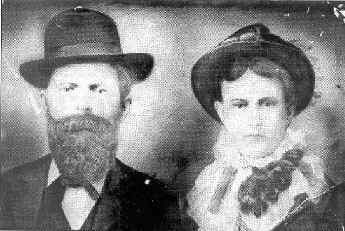
photo of Huey P. Long, Sr. and wife Caledonia Tyson Long, parents of
three Louisiana politicians,
Julius T. Long, Huey P. Long, Jr.,
and Earl K. Long.
"I consider the people of Winn Parish home folks and the people
of Louisiana my good neighbors," said Lieutenant Governor Earl K.
Long, when interviewed by the Winnfield News-American.
The
Lieutenant-Governor was at his home located just a few feet outside
the corporate limits of Winnfield, dressed in his work clothes for
he had been out on his farm looking after his stock. His father, the
late Huey P. Long, Sr. was a farmer and stockman before him, and
Earl's inclinations were also in that direction.
Unlike many
men in public life, Earl Long avoids wherever possible all publicity
and show. He meets the arguments of newspapers representatives by
saying, "I believe in being and doing what you are and going to do,
which I think speaks louder than anything I could or would say."
Earl Long comes from a family with a long and colorful history.
His ancestry dates back to the colonial days. Their valor in war and
able leadership in civic and political affairs are a matter of
records. When reminded of this noble ancestry, the
Lieutenant-Governor smiled and said, "These are the ones we have
heard about. I don't know about some of the others 'cause no records
was kept."
Louisiana's Lieutenant-Governor is the
great-great-grandson of James Long of Baltimore, Maryland, a patriot
of Revolutionary War fame. John Long, the father of James Long, saw
service in the French and Indian Wars in 1748. Two other colonial
ancestors, outstanding officers and statesman and prominent in early
affairs of Maryland were Colonel Ninian Beall and Captain Richard
Owings. Colonel Beall, an officer in the Scotch-English army raised
against Oliver Cromwell, arrived in Maryland in 1658. He was the
first elder in the Presbyterian church in American, according to
records.
Earl Long is also related to the Wingates of
Mississippi and Texas, prominent in the Southern Confederacy. Edward
Wingate moved during the period of the Civil War to Texas. There, he
became a colorful figure in establishing the Republic of Texas.
On his mother's side, the lieutenant-governor is related to the
Tysons, another of the first families of this section. His mother
was Miss Caledonia Tyson, considered one of the most beautiful women
of her time and a most gracious and charming hostess. After her
marriage in 1875 to Huey P. Long, her home was one of the most
hospitable in the countryside.
Her children's future was of
much concern to her and she took advantage of every opportunity to
further her ambitions for them. She encouraged them to attend higher
educational institutions. Before her death in 1913 she realized her
ambitions as they were all well on their way to becoming outstanding
men and women.
Earl Long attended the public schools of
Winnfield and in 1926 graduated from Loyola University Law School.
Between his public school and university days he was a traveling
salesman, and continued this while he studied at both Tulane and
Loyola.
His interest in politics was inherited as well as
cultivated. The youngest of four brothers, two of whom, Julius and
Huey, entered the political arena of their home parish and district
early, he had occasion to get a taste of political discussions at
home. Julius T. Long, his oldest brother, was elected district
attorney in about 1912 and later was a candidate for district judge.
Huey P. long, Jr., who later upset every political precedent known
in this and many other states, was elected in 1917 as Railroad
Commissioner. In 1924, Huey was a strong contender for the office of
governor. In 1928 he was elected governor. Earl Long did his part to
help his brothers attain these high officers.
He, like his
politically-inclined brothers, had his own opinions and frequently
disagreed with them, sometimes on minor questions and as often on
major issues.
Appointment as inheritance Tax attorney for
Orleans Parish in 1928 by his brother, Governor Huey P. Long, was
his first service in a political office.
Earl Long,
independent and without the support of any political group, was a
candidate for Lieutenant-Governor in 1932. Unsuccessful in his
almost single-handed fight, the large vote given him in North
Louisiana proved that he had a large personal following and
indicated his strength as a political figure. This, and the fact
that he was the brother of the assassinated Senator Huey P. Long,
was taken into account when he was sought by political leaders,
friends and supporters to become a candidate for Lieutenant Governor
in 1936. He overwhelmingly swept into office in one of the fastest
campaigns ever conducted.
Never appearing on the political
horizon, but preferring to remain in the background and do her part
as the wife and homemaker is Mrs. Long, who before their marriage in
1932 was Miss Blanche Revere of New Orleans. She is her husband's
constant companion and despite her quiet and unassuming manner, is
the most interested bystander in any audience, small or large.
Lieutenant-Governor Long has five sisters, Mrs. R. W. Davis, of
Ruston, Mrs Oliver Cooper, teacher of Art in Louisiana State Normal
College at Natchitoches, Mrs. Milton Knott of Many, Miss Callie Long
of Tucson, Arizona, and Mrs. Stewart Hunt of Ruston; two brother,
Julius T. Long attorney in Shreveport and Dr. George S. Long of
Monroe.
Coordinator: Vacant
State Coordinator: Marsha Holley
If you have questions or problems with this site, email Marsha Holley, State Coordinator.
